

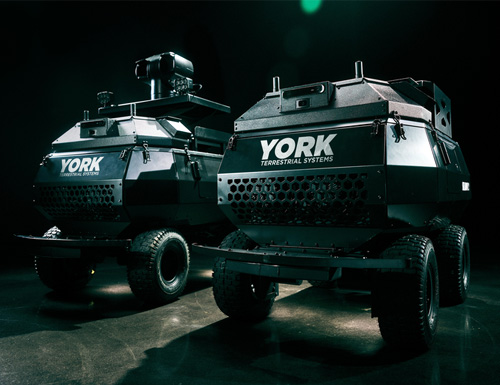
Upon closing, Outlook will form the foundation of York Terrestrial Systems, marking York’s entry into terrestrial systems and extending its capabilities to include unmanned platforms connected by its proven space, ground, and communications infrastructure. The acquisition represents the next step in completing York’s integrated ecosystem for unmanned operations, from flight-proven spacecraft and global ground infrastructure to mobile communications terminals and systems operating in the field. York will host an investor call on Thursday, November 19 at 5PM ET to discuss the proposed acquisition and its expansion into unmanned systems.
York estimates the planned acquisition will open access to an additional addressable market estimated to be $3.08 billion for unmanned ground systems. Combined with ALL.SPACE’s mobile satellite communications terminals and ATLAS’ global ground network, the acquisition also positions York to expand into the estimated $10.31 billion unmanned surface and underwater vessel markets. York’s integrated architecture is designed to connect operators with distributed fleets across domains, sustain mission-critical communications in contested environments, and keep warfighters farther from the fight.
“The future of national defense will be defined by the ability to deploy and coordinate large fleets of unmanned systems while keeping the people commanding them farther from danger,” said Dirk Wallinger, CEO of York. “York has been building the architecture that makes that possible, from proven spacecraft and global ground infrastructure to mobile terminals and mission software. With Outlook, we intend to deliver the unmanned systems operating at the edge of that network as well. This is a defining step in our ability to provide the integrated systems our customers will need to fight and win.”
Recent statements by Department of War leadership reinforce that scaling autonomous and unmanned systems is a priority for the U.S. government. York’s proposed acquisition addresses the integrated platforms, resilient communications, and mission software needed to translate that priority into operational capability across domains.
Operating unmanned fleets at scale requires connectivity that extends beyond local networks and individual theaters where distance, terrain, and threats to terrestrial infrastructure can limit ground-based communications and air superiority cannot be assumed. Space provides the wide-area backbone needed to connect distributed fleets with remote operators, exchange mission data across domains, and keep warfighters farther from the fight. York is combining that backbone with resilient communications, mission software, and onboard capabilities to support increasingly autonomous operations, including where terrestrial communications are disrupted and GPS is degraded or denied.
Shadow, the initial platform planned for York Terrestrial Systems, is a long-endurance unmanned ground system designed for persistent intelligence and mobile communications in demanding operational environments. Built to withstand gunfire and harsh environmental conditions, Shadow is engineered to support survivability in active conflict zones. Battery power and an automatic fuel-powered generator support operational endurance of 30 to more than 45 days. York plans to integrate Shadow with ALL.SPACE’s multi-link, multi-orbit terminal technology, connecting the platform to its broader space and ground architecture through multiple satellite communications paths that reduce reliance on a single link. Shadow will be manufactured by York in the United States.
York’s existing ecosystem provides the infrastructure to connect and enable Outlook’s unmanned platforms, linking flight-proven spacecraft with approximately 50 ATLAS ground antennas across a global network and ALL.SPACE terminals designed to maintain resilient satellite connectivity for mobile assets across domains, including in contested environments. York currently operates five missions across three constellations through three operations centers, bringing proven experience in managing distributed assets to its expanding unmanned systems portfolio. York intends to integrate these capabilities to support distributed unmanned missions, with resilient communications and software connecting platforms, operators, and mission data.
“Unmanned systems at scale will change military operations as profoundly as industrialization changed warfare a century ago,” Wallinger added. “Success will depend on how effectively those systems work together and how far we can separate the operator from the threat. York is bringing together the platforms, connectivity, and operational infrastructure to make that possible.”
The proposed acquisition builds on York’s $755 million investment in production capacity and spacecraft inventory, alongside its expansion into ground infrastructure, communications, and software. Adding Outlook’s unmanned platforms advances York’s ability to deliver integrated systems from orbit to the operational edge as a modern defense prime built for speed and scale.
York will host an investor call on Thursday, November 19 at 5PM ET to provide additional details on the proposed acquisition of Outlook Industries and the planned establishment of York Terrestrial Systems. The call will include a presentation by York management followed by a question-and-answer session. Participation details are available at https://ir.yorkspacesystems.com/events-and-presentations/default.aspx.
About York Space Systems
York Space Systems is a leading, U.S.-based national defense and commercial prime providing a comprehensive suite of mission-critical solutions for national security, government, and commercial customers. York is one of the only space and defense primes with proprietary hardware and software capabilities designed to address customers’ complex mission requirements across the critical elements of the entire space ecosystem throughout the mission lifecycle. York is purpose built to address evolving national security space challenges and to adapt to the ongoing shift in the U.S. government’s mission needs and procurement proc


